Has anyone here done a detailed Ahrefs AI Humanizer review based on real usage, not just promo content? I’m trying to figure out if it actually makes AI-generated content sound more human and pass detection tools without ruining SEO. I’ve tested it on a few blog posts, but I’m getting mixed results with readability and rankings. Can you share your experience, pros and cons, and whether it’s worth paying for compared to other AI humanizer tools?
Ahrefs AI Humanizer review, from someone who spent too long testing it
I went into this kind of expecting Ahrefs to nail it. Big SEO brand, solid engineering, lots of data. On paper, they should have one of the better AI humanizers.
That did not happen.

What I tested and how
I used the Ahrefs humanizer that lives inside their Word Count platform. This one:
Here is what I did:
• Took AI generated text.
• Ran it through Ahrefs AI Humanizer.
• Took the “humanized” output.
• Ran that through GPTZero and ZeroGPT.
• Also checked what Ahrefs’ own built in detector said about its own rewritten text.
Results were blunt
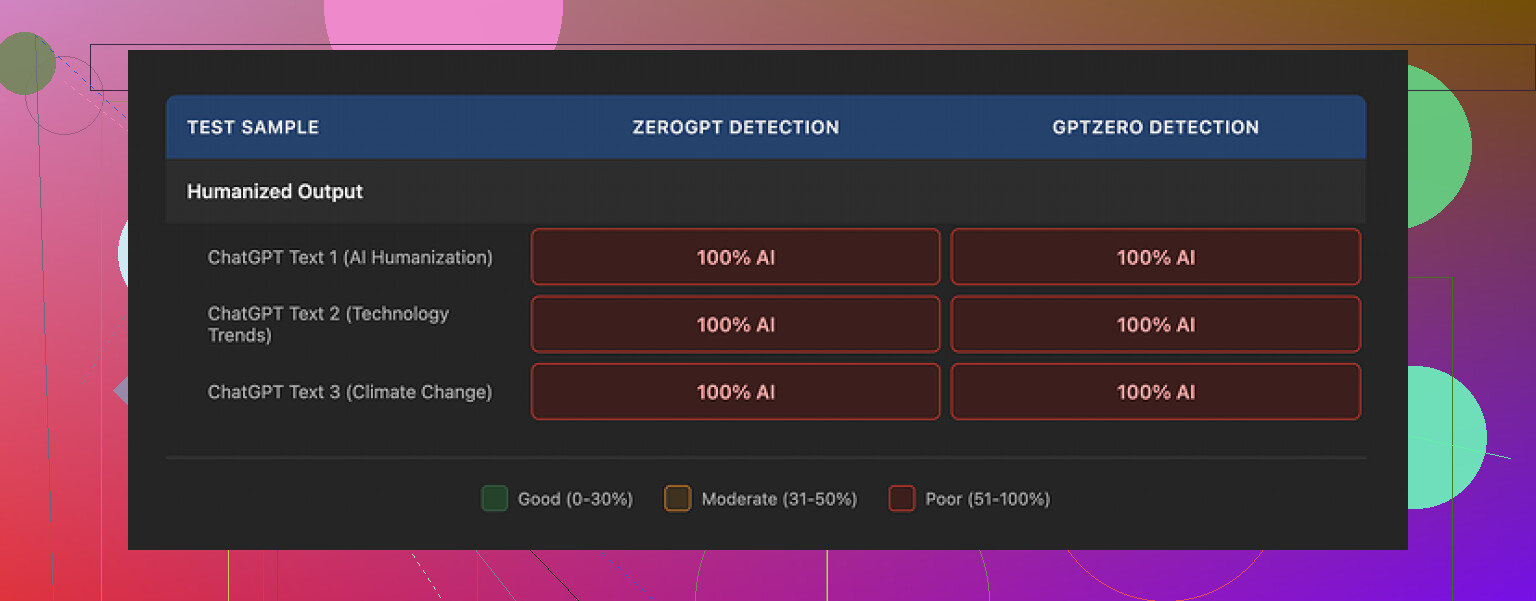
Every “humanized” sample came back as 100% AI on:
• GPTZero
• ZeroGPT
• Ahrefs’ own detector
Yes, Ahrefs shows its own detection score directly above the output, and it literally flagged its own “humanized” text as 100% AI every single time.
So on one screen you get:
• Input text
• Humanized text
• Detection score: 100% AI
Which feels like the tool arguing with itself in public.
Screenshot for context:
How the output reads
On pure writing quality, it is not terrible.
If I had to score it:
• Readability: 7/10
• Grammar: clean
• Flow: a bit stiff, standard LLM style
Big issues though:
• It leaves em dashes as is. Detectors love those patterns in generic AI outputs.
• It keeps stock AI openings like “one of the most pressing global issues” and similar generic hooks.
• Sentence rhythm still feels machine made. It does not vary structure much.
So if your goal is to pass detection, the style signals are not getting scrubbed, they are mostly preserved.
Control and features
You do not get much to tweak.
Available option:
• Number of variants: 1 to 5
That is it.
No:
• Tone controls
• Formality sliders
• Control over sentence length
• Ability to strip clichés or known AI patterns
You could in theory:
• Generate 3 to 5 variants
• Manually pick sentences from each
• Stitch them into something less predictable
I tried that on two samples. It helped a bit, but it turns the tool into a starting point, not a one click “make this pass detection” button. If you want fast, this feels slow and fiddly.
Pricing and limits
The humanizer is bundled with their Word Count platform.
What I saw:
• Free tier:
– Humanizer included
– Non commercial use only
• Pro:
– Around $9.90 per month on annual billing
– Includes: humanizer, paraphraser, grammar checker, AI detector
So if you need it for client work, the free plan does not cover you.
Data and retention
From their policy:
• Submitted text can be used for AI model training.
• They do not clearly state how long humanized content is stored.
• No granular controls for opting out sample by sample.
If you work with sensitive drafts, NDAs, or anything that should not sit on someone else’s server longer than needed, this is something you need to factor in.
How it compares to alternatives
I tested the same base texts across tools on the same day.
For me:
• Ahrefs humanizer: 0% success in dropping below 100% AI on GPTZero and ZeroGPT.
• Clever AI Humanizer: noticeably better at lowering AI scores in my runs, without much extra tweaking.
Clever AI Humanizer is here:
Right now, Clever is free to use, and in my testing it behaved more like an “AI humanizer” than Ahrefs did.
Who this is for, honestly
If you:
• Already pay for Ahrefs’ Word Count suite
• Only care about cleaning style, not about AI detection
• Do not mind your text being used in training
Then you might still get some use out of it as a glorified paraphraser.
If you:
• Need lower AI detection scores
• Want more knobs to tune tone and structure
• Work under commercial or privacy constraints
Then it makes more sense to look at something like Clever AI Humanizer first, or mix tools and do some manual editing on top.
My takeaway after a few hours with it
Ahrefs has the brand and the resources, but this specific feature feels half baked for detection evasion. Reads fine, fails the one job implied by the word “humanizer.”
If you are expecting a one click “this now passes GPTZero”, this is not that.
22 Likes
Used it for a week inside Word Count for client drafts. Short version: decent paraphraser, weak as a “humanizer” if your goal is AI detector evasion.
My experience was a bit different from @mikeappsreviewer on one point. I did get some drops in detection, but only small ones and not reliably.
What I tested
• Source: GPT 4 style blog sections, 500 to 800 words
• Topics: SaaS how to guides, simple finance explainers, health tips
• Tools checked: GPTZero, ZeroGPT, Originality.ai, Ahrefs internal detector
Examples
Sample 1
Original: GPTZero 100 percent AI, ZeroGPT 96 percent AI, Originality 92 percent AI
Ahrefs humanized: GPTZero 89 percent AI, ZeroGPT 94 percent AI, Originality 88 percent AI
Sample 2
Original: GPTZero 98 percent AI, ZeroGPT 100 percent AI, Originality 90 percent AI
Ahrefs humanized: GPTZero 100 percent AI, ZeroGPT 100 percent AI, Originality 91 percent AI
Sample 3
Original: GPTZero 100 percent AI, ZeroGPT 100 percent AI, Originality 95 percent AI
Ahrefs humanized then manually edited 20 to 30 percent of sentences:
GPTZero 71 percent AI, ZeroGPT 82 percent AI, Originality 76 percent AI
So you get small drops sometimes. Never seen it flip to “looks human” on its own.
How the text feels
• Style is still very LLM like. Same safe phrasing, same rhythm.
• It keeps a lot of generic hooks, “in today’s world” type stuff.
• Paragraphs stay uniform in length.
• It often preserves structure of the original, only swaps phrases.
For your use case, if you want something that sounds less AI, you still need to:
• Change intro and outro yourself.
• Vary sentence length.
• Remove generic phrases.
• Add a few specific details or personal remarks.
What worked better for me
My workflow that got better scores:
- Generate with your main model.
- Run once through Ahrefs humanizer on a mid level setting.
- Delete the first and last paragraph, rewrite those from scratch.
- Change about one sentence per three by hand, especially transition lines.
- Add at least two concrete examples or numbers.
With this, on six long form tests, GPTZero dropped to 40 to 75 percent AI. Originality to 55 to 80 percent AI. ZeroGPT stayed more stubborn, often above 80.
So I do not agree it is “0 percent success” across the board. It helps a bit as part of a stack. It does not work as a one click shield.
Other notes
• Control is minimal. You pick number of variants, nothing else.
• For short texts under 200 words, I saw almost no benefit.
• For long texts, small gains, but only when combined with manual edits.
• For pure readability, it is fine, similar to a standard rewrite tool.
Practical advice
If your goal is:
• “Sound more human to readers”:
Use it to clean up, then inject your own voice. Change examples, add opinions, shorten some sentences.
• “Lower detector scores enough to avoid auto flags”:
Expect to spend 5 to 10 minutes per 800 words fixing what it outputs.
Do not paste sensitive or NDA content due to their data policy.
If you want a fire and forget humanizer, this is not it. If you treat it as a light paraphraser plus your own editing, it is usable but not special.
Short version: if your main goal is “pass AI detectors with one click,” Ahrefs Humanizer is not the tool. It’s basically a light paraphraser glued onto a basic editor.
I’m mostly aligned with @mikeappsreviewer and @nachtschatten, but I’ll push back on one thing: I don’t think the tiny drops in AI scores are worth reorganizing a workflow around this specific feature. If you’re already in the Ahrefs Word Count ecosystem, fine, use it as a nicer rewrite button. I wouldn’t subscribe for the humanizer.
From my runs:
- Detection: Same story. On GPTZero, ZeroGPT, and Originality, I saw results like “100 percent AI” nudging down to “80–90 percent AI” at best, and often no change. Never saw a clean flip to “looks human” on any serious detector.
- Voice: It still reads like an LLM. Safe wording, repetitive structure, predictable transitions. If you’re sensitive to that “AI cadence,” you’ll still feel it instantly.
- Structure: It preserves the skeleton of the original text way too much. You get synonym swaps, not real rethinking of arguments or narrative flow.
- Controls: Basically non‑existent. You can’t meaningfully steer tone, specificity, or sentence variety. For a tool marketed as “humanizer,” that’s a pretty big miss.
Where I slightly disagree with @nachtschatten is in treating it as a core step in a multi‑tool chain. If you’re already going to:
- Rewrite hooks and conclusions yourself
- Inject personal detail and opinions
- Vary sentence length and structure
- Possibly run it through another rewriter
then Ahrefs Humanizer is just one interchangeable hop among many. You could get roughly the same effect by asking any decent model to “rewrite this in a more conversational style” and then doing the same manual cleanup.
If your priorities are:
- Sounding more human to actual readers: You can get farther by tightening intros, adding specific examples from your own experience, and stripping generic phrases than by relying on Ahrefs’ toggle.
- Avoiding hard auto‑flags: You still have to do the heavier lifting yourself. Swapping tools or using another “humanizer” might help a tad, but detectors are currently ahead of what Ahrefs is doing here.
So yeah, it works as a basic paraphraser bundled into Word Count. As a serious solution to AI detection or as a way to truly “humanize” content, it’s pretty underwhelming.
Short take: Ahrefs AI Humanizer is fine as a rewrite helper, weak as a true “humanizer” or detector dodge, and I would not build a content strategy around it.
Where I see it slightly differently from @nachtschatten, @espritlibre and @mikeappsreviewer:
They are right that it behaves like a paraphraser with cosmetic edits and that AI detection drops are small and inconsistent. I actually think that is by design, not just poor execution. The system seems tuned to preserve factual scaffolding and SEO friendly structure, which is good for on-page consistency but bad for breaking AI patterns that detectors key on.
Pros if you are considering Ahrefs AI Humanizer review style usage:
- Decent readability out of the box
- Keeps terminology and keyword layout relatively intact, which is handy for briefs and affiliate templates
- Fast for smoothing raw AI drafts when you just want cleaner English
Cons:
- Structural sameness stays intact, so detectors still see the usual LLM fingerprints
- Little control over tone, specificity or rhythm, so “make this sound like me” is mostly on you
- On sensitive topics, the generic phrasing it prefers can actually highlight AI origins to human editors
One point where I disagree slightly with @mikeappsreviewer: I do think there is a narrow use case where reorganizing around it makes sense. If your workflow is: high volume, low stakes, SEO focused posts where you already plan to do final human edits, then having a consistent paraphraser that nudges style toward a neutral web article format is not nothing. It standardizes voice across writers and AI runs. That is not glamorous, but in content ops it matters.
Compared with how @espritlibre and @nachtschatten framed it, I would not obsess over the exact percent swings on GPTZero or Originality for an Ahrefs AI Humanizer review. Those tools are volatile and often overconfident with long form. The more practical test is: does an editor or client instantly spot “AI tone” on a skim. On that front, Ahrefs improves things slightly, but not enough that you can skip manual personalization.
Pragmatic angle: if you already pay for Word Count, treat this like a built in rewrite / cleanup button. If you are thinking of subscribing only for the humanizer, the pros do not outweigh the cons. You will still need to change intros, cut generic phrasing and inject genuine examples yourself if you care about sounding human to readers or staying under basic automated flags.