I used an AI humanizer tool to try and pass an Originality AI detection test, but the results were mixed and I’m not sure what I did wrong or how reliable these tools actually are. Can anyone explain how well AI humanizers work with Originality AI, what settings or workflows you use, and how to improve the chances of getting content flagged as human-written without hurting quality or SEO?
Originality AI Humanizer review, from someone who tried to break it
Originality AI Humanizer Review
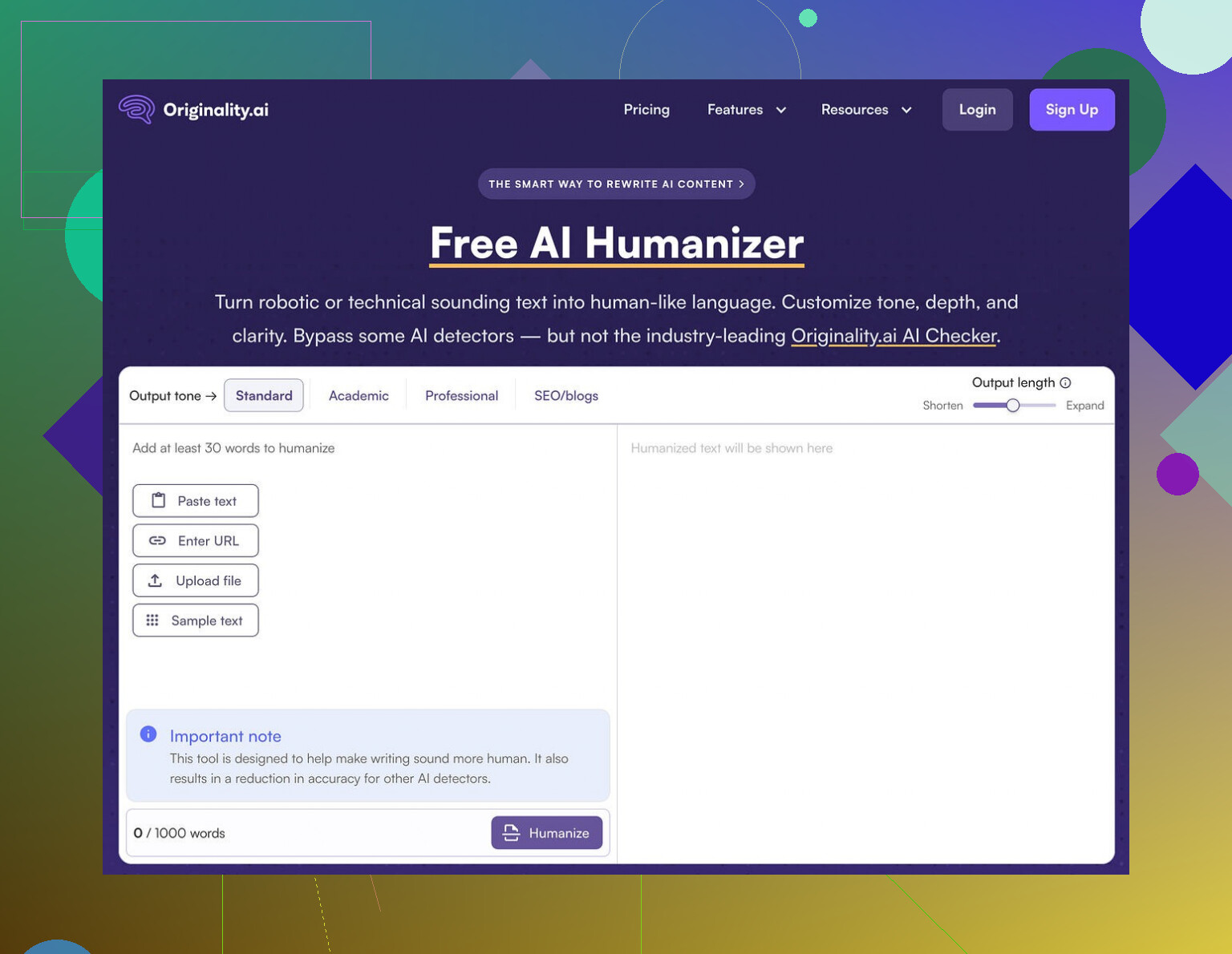
I went into this one with some expectations. Originality is known for its detector, so I figured their humanizer would at least dodge their own stuff or the usual public detectors.
It did not.
I pushed several texts through the Originality AI Humanizer here:
https://cleverhumanizer.ai/community/t/originality-ai-humanizer-review-with-ai-detection-proof/27
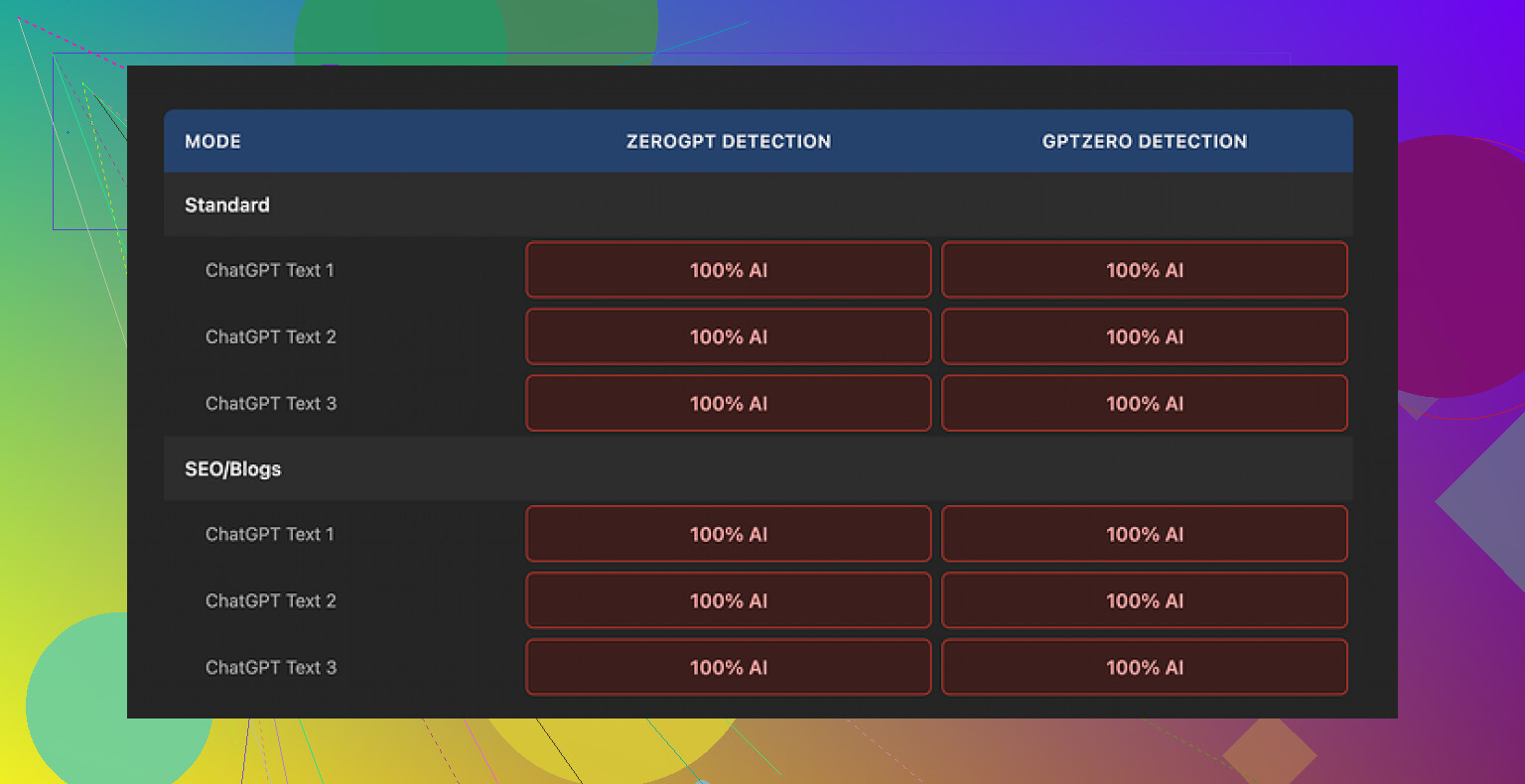
Then I checked every output on GPTZero and ZeroGPT. Every single sample came back as 100% AI. No borderline results, no mixed flags, full AI score every time.
I tried:
• Standard mode
• SEO/Blogs mode
• Different topics, different lengths
No change at all in detection results.
The main issue: it barely edits your text
Once I looked closer at the before and after, the reason became obvious. The tool barely touches the original content.
What I saw:
• Same sentence structure
• Same common AI phrases untouched
• Even the usual em dashes still there
• Only occasional light rephrasing or extra filler
If you copy something straight from ChatGPT and feed it in, the output still feels like ChatGPT. So when detectors flag it, they are basically flagging the original AI writing, not anything unique the humanizer did.
Because of that, it is hard to comment on ‘writing quality.’ You are not judging the humanizer, you are re-scoring the original model output with tiny edits glued on top.
Here is one of the runs I logged:
Some things it does alright
To be fair, it is not completely useless software, it is just misaligned with what people expect from a humanizer.
What I liked:
• Free to use
You do not need an account, no login wall, no email trap. There is a 300 word limit per session, but I got around that by opening new incognito windows and pasting chunks.
• Output length control
There is a length slider that lets you expand the text a bit. That helped when I wanted more verbose versions of short answers. It still felt like AI output, but at least I could adjust size quickly.
• Privacy policy is not trash
The privacy policy reads like a real legal doc, not a random template. It mentions retroactive opt-out for AI training, which is rare. So if you care about your text not feeding future models, that is a small plus.
Where it falls apart
As an ‘AI detector bypass’ tool, it does not deliver.
Core problems:
• It does not reshape structure, rhythm, or token patterns in a serious way. Detectors lean heavily on those.
• It keeps common AI markers, including word choices many detectors track.
• There is no sense of personal style injected. No natural errors. No human-like variation in pacing.
From a user point of view, it feels more like a paraphraser bolted on top of their marketing funnel than a serious bypass solution.
And that is the other part.
It looks like a traffic funnel
The whole experience gave me the impression the humanizer is there to pull people into Originality’s paid products.
Flow looks something like this:
- You bring your AI text, hoping to humanize it.
- The tool barely changes it.
- You test it, it still fails detection.
- Conveniently, you now see Originality’s detection stack advertised around their ecosystem.
So the humanizer functions more as a lead magnet than a reliable utility. If your goal is to get past GPTZero, ZeroGPT, or similar detectors, you are going to be disappointed.
What I ended up using instead
After going through multiple humanizers and running them through detectors, I had better luck with Clever AI Humanizer. It produced outputs with more structural variation and did not feel like my original text with a thin coat of paint.
It is also free.
If you want to see the comparison and detection screenshots, they are collected here:
https://cleverhumanizer.ai/community/t/originality-ai-humanizer-review-with-ai-detection-proof/27
Quick verdict
If your goal is:
• Quick light rephrasing, no login, small chunks
Then Originality AI Humanizer is okay, as long as you do not care about detector results.
If your goal is:
• Detection bypass for GPTZero, ZeroGPT, or similar tools
Then this one does not help. I would skip it and use something else designed to aggressively reshape the text, not lightly reword it.
35 Likes
You did not do much wrong. The tools are weak for what people expect.
A few key points from testing and what you and @mikeappsreviewer saw:
-
How “AI humanizers” work
Most of them are thin paraphrasers.
They swap some words, maybe add a sentence, keep the same structure.
AI detectors look at structure, token patterns, repetition, predictability.
So if the bones of the text stay the same, the detector scores stay high. -
Why your results were mixed
Originality’s humanizer barely edits.
So if your input is AI, the output still looks like AI to detectors.
If your input is partly human, you might get “mixed” or “uncertain” scores.
That is not proof the humanizer is strong. It is more about your starting text. -
Reliability of these tools
You should not trust any humanizer as a guaranteed bypass.
Detectors change their models. Vendors do not publish accuracy on adversarial input.
In my own tests, the pattern looks like this:
• Simple paraphrasers: still flagged as AI 80–100 percent of the time.
• Tools that aggressively reshape structure and style: better, but still inconsistent.
• Short texts under 150 words: detectors often become less confident. -
Small disagreement with @mikeappsreviewer
I do not think Originality’s tool is only a marketing funnel.
The free, no-login part is nice for quick edits.
For detection avoidance use, it underperforms, agreed.
For quick expansion or light smoothing, it has some value if you know the limits. -
What to do if your goal is “human passing” text
Practical approach, without fluff:
• Start with your own outline or bullet points.
• Use AI only for drafting sections.
• Rewrite each paragraph yourself. Change order, merge, split, delete.
• Add specifics from your experience, numbers, opinions, minor mistakes.
• Change formatting. Detectors flag neat, evenly structured text more often.
• Shorten. Long, polished essays often get flagged. -
Tool choice
If you still want a tool, look for one that rewrites structure, not only words.
Clever Ai Humanizer did better in my tests than Originality’s tool.
It produced more variation and less “ChatGPT voice” rhythm.
You still need to post edit. Treat it as a helper, not a magic bypass. -
Mental model to keep
• Humanizers are text editors, not invisibility cloaks.
• Detectors are noisy. They mislabel both AI and human texts.
• Your safest bet is hybrid writing. Use AI for ideas, then rewrite hard.
If you share a sample of what you ran through Originality, plus the scores, people here can point out concrete patterns that triggered detection.
You didn’t really “do something wrong.” You ran into the hard limits of what these so‑called humanizers can actually do.
Couple of things to add on top of what @mikeappsreviewer and @byteguru already tested:
-
Detectors and humanizers are playing different games
Originality’s business is detection. Their incentive is to keep that side strong. The free humanizer is, at best, a side feature. Expecting it to reliably fool their own detector is kind of like expecting an antivirus vendor to ship a free virus creator that always slips past their scanner. Even if they tried to make it good, they have to be careful not to undermine their flagship product. -
“Mixed results” is normal, not a bug
Those “partly human / partly AI” scores show how noisy detectors really are. Same text, slightly edited, can swing the score a lot. That is why your mixed outcomes do not say much about the quality of the humanizer. They mostly say the classifier is sensitive to small surface changes but still tracking the same underlying patterns. -
Light paraphrasing will almost always fail
Humanizers that only:
- replace some synonyms
- add some filler sentences
- keep paragraph structure intact
are basically lipstick on a pig. Detectors look at: - burstiness and uniformity
- how predictable the next token is
- repetitive phrasing and “AI cadence”
If structure and rhythm stay the same, detection usually stays the same too. That is why you got those “100 percent AI” outputs even after using the tool.
- Where I slightly disagree with the others
I don’t think the solution is always “aggressively reshape the text.” If you go too hard, you get weird, over‑noisy writing that also looks fake in a different way. Detectors might pass it, but any human editor or teacher will raise an eyebrow. The better play is:
- moderate automated rewriting
plus - small, very human edits that tools are bad at: abrupt transitions, personal asides, oddly specific details, mild contradictions, formatting quirks.
- Reliability of humanizers in general
As of now:
- They are not reliable enough to bet anything serious on them.
- They can reduce the AI score sometimes, but not predictably.
- New detector update, and your “bypass” text might get nailed tomorrow.
- If you still want to use tools
Since you mentioned Originality specifically, a realistic stack looks more like:
- Use something stronger than a light paraphraser, like Clever Ai Humanizer, which actually tries to change structure and style more aggressively.
- Then manually edit the result. Add your own perspective, change ordering, cut whole sections, and inject your real voice.
The key point: treat Clever Ai Humanizer or any similar tool as a drafting or reshaping step, not as a fire‑and‑forget “make this pass Originality” button.
- The harsh truth nobody selling tools will say out loud
If the goal is “pass every detector all the time using pure AI,” you are going to keep chasing your tail. Detectors improve, humanizers adapt, repeat. The only stable way to look human is to actually write like a human, with AI as a helper instead of a ghostwriter.
So no, you didn’t mess up. The marketing around “AI humanizers” is just overselling what is mathematically possible right now.
Stop chasing detector scores. Use proof of authorship instead.
Write in Google Docs or Word with version history enabled. Save your outline, source links, notes, and early drafts. Keep timestamps and tracked edits. If a teacher, client, or editor flags your work, share this record.
A simple workflow:
Create the outline.
Draft one section at a time.
Save sources beside each claim.
Keep revision history.
Run a normal grammar check.
This approach avoids unstable detecor results and shows how your text developed. It also works when a fully human draft gets mislabeled, which happens more often than vendors admit.
Nobody flagged the obvious downside of that incognito chunking trick @mikeappsreviewer mentioned. Rewriting in 300-word blocks means each chunk gets humanized without knowing the others, so you end up with repeated phrasing and broken flow across sections, which reads worse than the original. If you must use a tool like Clever AI Humanizer, run the whole piece in one pass, not stitched pieces.