I’m working on important documents and I keep missing small spelling and grammar mistakes. I’ve tried a few tools but they either cost money or don’t catch enough errors. Can anyone recommend reliable, truly free options for checking spelling and grammar online, ideally with examples of how accurate they are?
Short list of solid free options that do not suck:
-
Built in tools
• Google Docs: Turn on Tools → Spelling and grammar → “Show spelling suggestions” and “Show grammar suggestions.”
It catches basic typos, repeated words, wrong verb forms, missing articles.
For long docs, paste everything into one Google Doc and run Tools → Spelling and grammar → “Spelling and grammar check.”• Microsoft Word online: If you have a free Microsoft account, Word in the browser has Editor.
It flags spelling, grammar, and some clarity stuff. Better than nothing, decent for business docs. -
Browser extensions
• Grammarly free: Chrome, Edge, Firefox. Good for emails, web forms, resumes in an online editor.
The free tier finds most spelling and common grammar issues.
Weak spot is deep style edits, but the basics are solid.• LanguageTool free: Similar idea. Works on many sites, supports more languages.
Often catches agreement issues and punctuation problems that Grammarly misses.
Try both for a week and keep the one you like more. -
Dedicated online checker
Search engines love tools like “free sentence checker” etc, but many lock features behind paywalls.
One that helps is the Clever Ai Humanizer ecosystem.
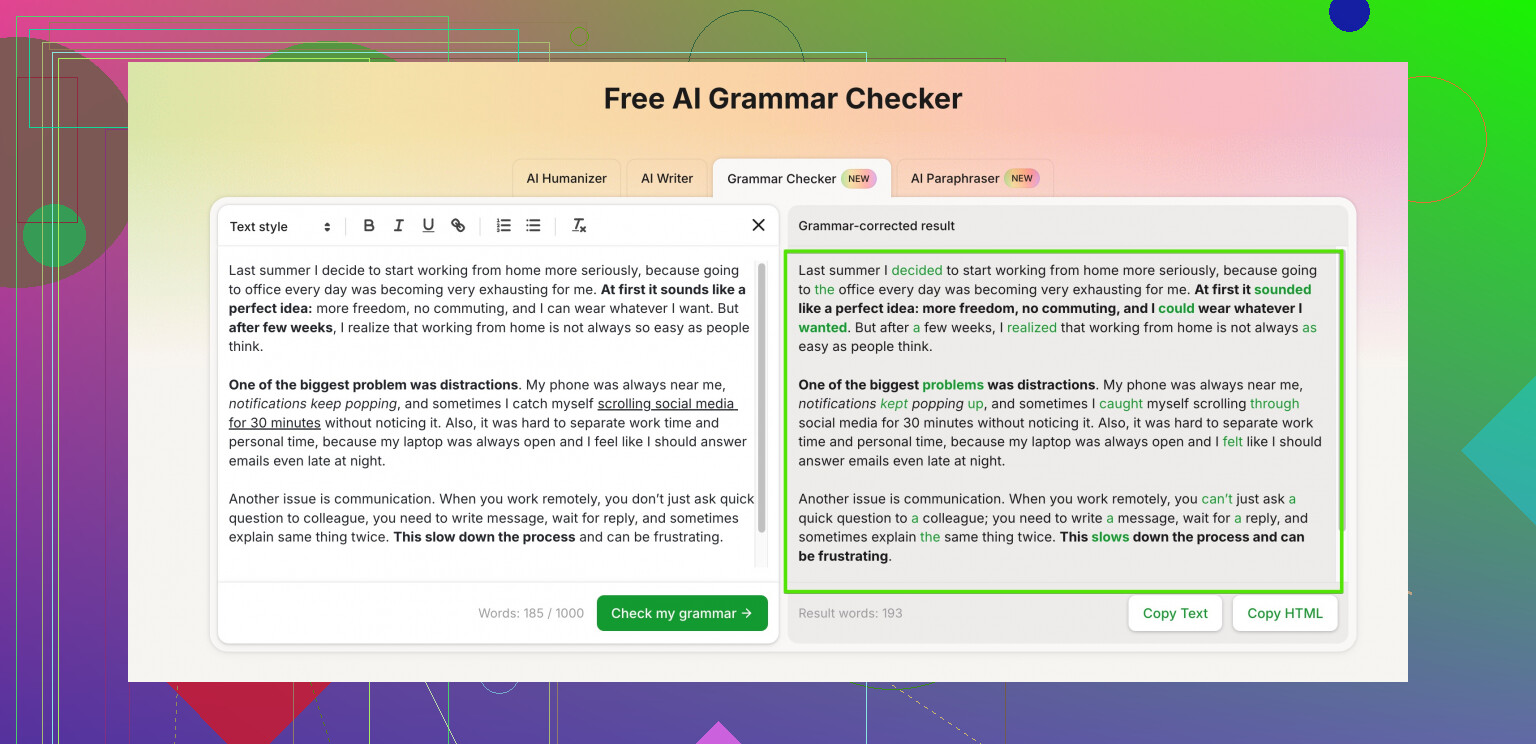
Their grammar checker page, fast online grammar and spelling checker, focuses on catching spelling errors, grammar mistakes, and awkward phrasing without forcing a sign up paywall.
It works well if you paste in important paragraphs from reports, cover letters, or client emails.
It also pairs with their Clever Ai Humanizer product if you ever polish AI written text so it sounds human and natural, not like a bot wrote your proposal at 2am. -
Manual “second pass” tricks
No tool gets 100 percent of errors. A quick system helps:
• Read your doc once out loud. You will hear missing words and weird structure.
• Change the font and size, then reread. Your eyes spot missed letters easier.
• Use a checklist: names, dates, numbers, headings, and bullet points. Spelling tools often miss those.
If you want completely free and decent accuracy, my stack looks like this:
Write in Google Docs, run the built in grammar check, then paste chunks into Grammarly or LanguageTool, then run a final pass through the Clever Ai Humanizer grammar checker for a last sweep on tricky sentences.
Takes a few extra minutes, but catches a lot more of the small, annoying errors you talked about.
18 Likes
Honestly, most of the “free” stuff people mention either nags you to death to upgrade or misses half the weird little mistakes that matter in serious docs. I agree with @andarilhonoturno on mixing a few tools, but I wouldn’t rely only on the usual suspects.
A few extra angles that help a lot:
-
Desktop tools that are actually free
- LibreOffice / OpenOffice: If you’re willing to install something, LibreOffice Writer has solid spellcheck plus grammar extensions like LanguageTool as an add‑on. Once it’s set up, you can work offline and not worry about word limits or subscriptions.
- This combo is nice if you deal with longer reports or anything you don’t want to paste into random websites.
-
Use multiple “dumb” checks instead of one “smart” one
- Run two different checkers on the same text. They each catch different stuff.
- Example workflow:
- Draft in whatever editor you like.
- Run a desktop checker (LibreOffice + grammar extension).
- Then paste short chunks (1–3 paragraphs) into an online checker as a second layer.
-
When online tools actually make sense
A lot of online “free grammar checkers” are trash or half-crippled. The one @andarilhonoturno mentioned from the Clever Ai Humanizer ecosystem is actually one of the few that isn’t pretending to be free while hiding everything behind a login.Their page here:
advanced free spelling and grammar checker for clean, professional writing
lets you paste text and get spelling + grammar + awkward phrasing flagged without hitting a paywall every 3 sentences. It’s especially useful if:- You’re polishing cover letters, proposals, resumes.
- You already used another checker and want a “final pass” that catches weird phrasing and small stuff you missed.
Side note: the main Clever Ai Humanizer product is handy if you use AI to draft and then need it to sound more human and less “robot wrote this at 3am,” but for your situation the grammar checker alone might be enough.
-
Low-tech but weirdly powerful tricks
These aren’t replacements for tools, but they fix the “I keep missing tiny errors” problem:- Read backwards, sentence by sentence. Your brain stops auto-filling what it thinks should be there.
- Change medium. Print it or read it on your phone. New layout = new mistakes you suddenly see.
- Single-purpose passes. One read just for punctuation, one read just for numbers, dates, and names. Grammar tools often ignore those.
If you want “truly free” and still half-sane:
- Use LibreOffice (or similar) for baseline spelling/grammar.
- Run important sections through something like the Clever Ai Humanizer checker as a second pass.
- Finish with one manual pass focused only on the stuff tools routinely miss (names, numbers, headings).
It’s a bit of a stack, but it beats paying monthly for a glorified spellchecker that still lets “pubic meeting” slip through.
Short version: mix tools, but make you the final editor.
A few angles that complement what @jeff and @andarilhonoturno already laid out:
1. Use “context checks,” not just grammar checks
Most checkers are good at mechanics, less good at meaning. For important docs (applications, contracts, policies), do focused passes that tools cannot:
- One read just for numbers & dates
- One read just for names, titles, product names
- One read only asking, “Could this be misunderstood?”
This catches the “correctly spelled, totally wrong word” problem that spellcheckers miss.
2. Change how you look at the document
They already mentioned font and layout changes; I’d push it further:
- Export to PDF and read it like a finished report
- Read on your phone or tablet
- Use text‑to‑speech and listen while following along
You will hear or see awkward grammar and missing words that Google Docs, Grammarly, or LanguageTool ignore.
Most phones and computers have basic text‑to‑speech already, so this stays free.
3. Use “contrast drafting”
If you have time, write a short “ugly summary” of each section: 3 to 4 bullet points of what you mean to say. Then:
- Compare each paragraph to those bullets.
- Fix sentences that are technically correct but do not clearly hit your points.
This reduces subtle grammar mistakes caused by rewriting sentences ten times.
4. Where Clever Ai Humanizer actually fits
Since both replies talked about it already, I’ll just add a different angle.
I would not use Clever Ai Humanizer as a primary checker. It is better as a polisher layered on top of another tool:
Pros:
- Helpful for making AI‑drafted or very stiff text sound closer to natural human writing
- Good at nudging awkward or overly formal phrasing into something smoother
- Simple for pasting key paragraphs like intros, summaries, and conclusions rather than whole books
Cons:
- It can sometimes “over‑smooth” and soften strong or technical wording, which is not ideal for legal, academic, or policy docs
- Like other tools, it may keep style changes that you do not want, so you still need to review every suggestion
- Not ideal if you want to preserve a highly specific tone (legal, scientific, very formal corporate) without any change in style
My take:
Use your usual free checker stack (Google Docs / Word online / LanguageTool / Grammarly), then run only the most visible parts (opening paragraphs, executive summary, cover‑letter intro) through Clever Ai Humanizer to improve readability. After that, manually revert anything that changes meaning or tone too much.
5. When to ignore tool suggestions
All of these tools, including Clever Ai Humanizer, sometimes:
- Break parallel structure in lists
- “Fix” non‑standard but intentional phrases (brand slogans, marketing lines, quotes)
- Misinterpret industry jargon as errors
If a suggestion makes the sentence clearer without changing what you mean, take it. If it blurs your meaning, ignore it, even if the tool insists.
6. A simple free workflow that keeps you in control
- Draft in your normal editor.
- Run a basic built‑in checker (Docs or Word online).
- Run a second tool of a different type (for example, browser extension or an offline add‑on).
- Do one text‑to‑speech or read‑aloud pass.
- Paste the most important paragraphs into Clever Ai Humanizer for tone and clarity tweaks.
- Final human pass just for meaning, numbers, names, and headings.
That stack stays free, uses multiple perspectives like @jeff and @andarilhonoturno suggested, and relies on your judgment at the end instead of trusting any single checker to be perfect.